BSF Acts: Week 16, Day 1: Notes

“Drawing Christ’s life from Him by which to live every day is the secret of the entire Christian life.”

The Jews of Paul’s day, and frankly many religions today, think of the path of religion as a high wire.  Each day you step out onto the wire and do your best not to fall.  You walk the straight and narrow, living a life of balance and moderation.  The winds of change and temptation provide challenges to your walk.

But the notes present a different kind of wire available to the Christian.  Ours is a wire to recharge and power up.  The wire isn’t legalistic rules, it is faith that keeps us connected to the ultimate power source – the creator of the entire universe.  We live by faith, we receive Christ by faith, we draw strength and hope and assurance of a resurrection life through faith.  We share this faith by showing others how to plug in and receive the power.  We help them plug into the word, the church and the spirit of God.

BSF Acts: Week 15, Day 5: 1 Thessalonians 4:13–5:11

Summary:

Do not lose hope or mourn the dead.  The promise of Jesus’ return and the reunion with him is not only for living believers, but for all, living and dead in a trumpet shout and majesty.

Questions:

12. a.  The Lord’s return is for all believers, living and dead.  Jesus’ promise of reunion is for all and, in fact, those who pass from this life experience the reunion first.
b. The magnitude of the reunion and yet that it will be a personal experience.  The power of the trumpet call of God and the eternity that it begins.
13. Belong to the day, wear faith and hope as armament, as something we physically put on each day for protection and strength.

14. a.  Give two points with verses (chapter 5). To light and to salvation (v5 and v9)
b. To suffer wrath
c. Encouraged because as I spend more time with God and in His love I grasp more fully the wrath that I so rightly deserve.  The fact that God who is loving and fair understand this so much more immensely and deeply than I do, yet, appoints me to receive a gift of salvation.

Conclusion:

What does it mean to belong to the day?  I think there are 2 aspects to this.  The first and most obvious is to live a life of transparency, as if all we do is in public, in the light.  In other words, if we are doing something we don’t want others to know about or see, then we are not living in the light, but in darkness.  However, it also means that we belong to the day of the Lord.  That everything about my life today should be pointed at and longing for today to be the day that the trumpet blows and Jesus comes to claim him believers from this world for an eternal reunion party.

BSF Acts: Week 15, Day 2: 1 Thessalonians 1 with Acts 17:1–10

Summary:  Interesting that we left last week discussing encouragement.  1 Thessalonians is a book overflowing with encouragement for a growing church.  You’re doing great, stay the course.  Stay true to what we modeled and taught you.  Challenge yourself to do more, grow more, love more, give more.  Stay assured and true.  There is also a repeating message of hope, hope for the family of believers, brothers and sisters, and hope for a reunion with Christ upon His return.

3.

1 Thes 1:10″and to wait for his Son from heaven”

2:19 For what is our hope, our joy, or the crown in which we will glory in the presence of our Lord Jesus when he comes? Is it not you?

3:13 May he strengthen your hearts so that you will be blameless and holy in the presence of our God and Father when our Lord Jesus comes with all his holy ones.

4:15 According to the Lord’s own word, we tell you that we who are still alive, who are left till the coming of the Lord, will certainly not precede those who have fallen asleep.

4:16 For the Lord himself will come down from heaven, with a loud command, with the voice of the archangel and with the trumpet call of God, and the dead in Christ will rise first.

5:2 for you know very well that the day of the Lord will come like a thief in the night.

5:23 May God himself, the God of peace, sanctify you through and through. May your whole spirit, soul and body be kept blameless at the coming of our Lord Jesus Christ.
4. Their strength came from the gospel, which they received and lived out withe the power of  the Holy Spirit and deep conviction.
5.  1:3 We continually remember before our God and Father your work produced by faith, your labor prompted by love, and your endurance inspired by hope in our Lord Jesus Christ.   Because this is the perfect eulogy.  What better thing could anyone say at your funeral

Conclusion: 1 Thessalonians is such a notable and encouraging book because it is so multi-faceted.  It provides a stable base to build on.  It provides a vision of what is to come.  It reinforces and strengthens the existing foundation and structure.  It encourages and admonishes continued growth.  It warns of pitfalls and concerns.  It beams love.

BSF Acts: Week 15, Day 4: 1 Thessalonians 4:1–12; 5:12–28

Summary

Faith is not just words that we say or a oath that we take.  It isn’t just an intellectual endeavor.  Faith is a changed life.  Faith is being brought into a new family.  Faith is being filled with the spirit and love of God and immediately beginning an eternal life, different that the ways of this world.

Questions
10. a.  The way we live our lives.  To be sanctified. To avoid sexual immorality.  To be holy and honorable.  To lead a quiet life, mind your own business, work with your hands. To acknowledge those who work hard and hold them in high regard.  To live in peace.  To warn those who are idle, encourage the disheartened, help the weak and be patient.  Strive to do what is good for everyone.  Rejoice always, pray continually, give thanks in all circumstances.  Reject evil.
b. They are opposite.  Current culture says focus on yourself only, look out for number 1.  Do what is fun and enjoyable.  Gossip and rumor and leisure are the entertainment of the day.
c. To warn the idle, encourage the disheartened and help the weak and most importantly – to be patient.  I very much need more patience with people.
11. a.  To give thanks in all circumstances.  Paul is such a great example of extreme persecution and extreme joy and rejoicing.
b. Through the holy spirit, through prophecy (the word of God), through God himself and the peace he provides.  Through God’s faithfulness.  Our responsibility is to not quench the spirit, to test the messages provided to us and hold to what is good.  To accept God’s strength.

Conclusion:

There are significant rewards to living a life pleasing to God.  Not something earned by this work, but in the same way that a father shows praise and encouragement to a good report card.  The love doesn’t come from the work, but it provides an opportunity to demonstrate it.

BSF Acts: Week 15, Day 3: 1 Thessalonians 2–3

Summary:  These central chapters of this book focus on the specific, personal, loving connection the authors have for the recipients of the letter.  This is family.  This is and overflowing love.

Questions:

6.

2:2 with the help of our God we dared to tell you his gospel

2:4 speek as thos approved by God to be entrusted with the gospel

2:7-8 cared for as a nursing mother, shared not only gospel but lives as well

2:9 Not a burden

2:10 holy righteous and blameless

2:12-13 As a father: encouraging, comforting and urging

3:10 Night and day we pray earnestly
7. a.  We are destined for trials and persecution.  But greater angst is in concern for other believers and greater joy comes from encouraging reports of them.
b.  Whenever I begin to feel that I stand strong on faith, challenges occur, discipline ebbs, energy wains.  My spirit is strengthened by the gospel and family of Christ, but that does not mean I don’t suffer temptation, weakness, doubt and fear.
8. a. 3:1 When we could stand it no longer.  3: 12 make your love overflow for each other and for everyone else as ours does for you.
b. Both are true, but in comparison, I am so reserved in my love for others.  I feel the love for fellow believers, particularly those I share with through BSF (especially the kids), but does it overflow?  Do I reach the point that “I could stand it no longer?”  I’m much more reserved and would love to be more free.
9.  A strong heart, strengthened by God, overflowing with love and waiting in anticipation for the return of Christ.

Conclusion: I am amazed by the love Paul felt.  I have felt homesick and longed to be back with family.  This is the closest I can relate to the feelings that Paul is expressing.  He not only calls the Thessalonian believers brothers and sisters, but he longs to reconnect and commune with them exactly like a mother or father longs to be with their family.

I’m Back – Understanding the need for discipline

You won’t find me bad-mouthing the Israelites in the desert.  God understood their immaturity and, as a result, provided the daily bread they needed on a daily basis.  I have the luxury of being able to spend time with God at any time, read the bible one day – or skip doing it for a day or week.  I started off using this online media to help with my discipline of doing a daily study, but as soon as we took a break from the study, my discipline faded.  I’m grateful that I’m given the provision to brush off and step back up and do better.  So, here we go.

Comfort

I was enjoying Christmas carols running through my head today as I worked and found myself singing the line: Good tidings of comfort and joy.

I think comfort and joy are great things to pursue and to offer to others as blessings.  The pursuit of happiness is part of what makes America what it is.  But what brings real comfort and joy?

According to the marketing messages I see on the internet, it could range anywhere from a tablet computer to clothing to the old standby: comfort food.  And while these items, particularly the comfort food  definitely bring comfort and joy (I forgot the rule never to write on your blog while hungry – sorry), we know they don’t bring comfort that lasts.  They also sure don’t bring lasting comfort in difficult times of sickness, sadness or death.  But what does?  The kids in my BSF class would answer “Jesus” (I think they have now figured out they can answer Jesus for almost any BSF question).  And while we know that is true, as adults we need more words.  That isn’t to say that we need more than Jesus provides, but we are longing for a deeper understanding and connection.

I turned to people smarter than I am and looked back at question 1 of the Heidelberg Catechism written in about 1563:

“What is your only comfort in life and death?”

The answer is:

“That I am not my own, but belong with body and soul, both in life and in death, to my faithful Saviour Jesus Christ. He has fully paid for all my sins with His precious blood, and has set me free from all the power of the devil. He also preserves me in such a way that without the will of my heavenly Father not a hair can fall from my head; indeed, all things must work together for my salvation. Therefore, by His Holy Spirit He also assures me of eternal life and makes me heartily willing and ready from now on to live for Him.”

I love how the first part of the answer to finding comfort is not “adding something more” but instead it is “letting something go” and recognizing I am not in charge.  I am free today because He has fully paid (past tense) for all my sins.  I am preserved, protected, assured and empowered by God.

But I think the most convicting line in being filled with comfort is the last: willing and ready from now on to live for Him.  How many of us struggle with the “from now on” part of that?  I mean, someday, after we die, we’ll live in heaven with Him.  But this says that comfort comes from living for Him today, now, not just in the future.   So much of our culture is focused on living a life for increased wealth, power and prestige.  But we know those things don’t bring comfort.  They just bring more longing.  There were some pretty smart folks 500 years ago – amazing how the #1 question then, for most people is still the #1 question today.

And, by the way – Good tidings of Comfort and Joy to you!

Another BTW:  This is officially my 100th post!  Thanks to all who read and comments and feedback are always welcome!

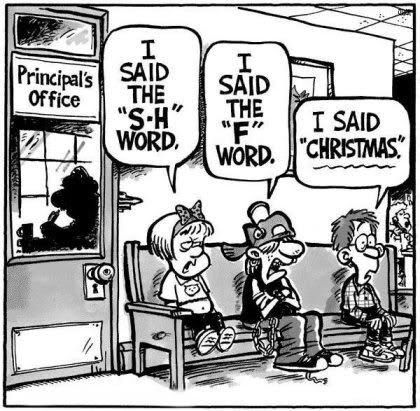
When did Christmas become a bad word?

Maybe I am just more sensitive to it this year, but it seems like there was a memo telling everyone to quit using the word “Christmas” and I didn’t get it.  Of the cards I’ve received 60% have been Happy Holidays, 30% Season’s Greetings and 10% Best Wishes for the Holiday Season.  Is there some reason we don’t just state which holiday everyone is talking about?

The retail community has no issue with calling it Christmas.  There are numerous websites reminders of how many days are left until that glorious day.  But go to a school or almost any workplace and you have to speak in code.  We are having a Winter concert where we will perform musical works such as Greensleeves (What Child is This?) and then afterward we will be having a holiday party where we will be exchanging gifts.

Everyone knows what holiday everyone is talking about.  Why are we speaking in code?

I come down to 5 possible conclusions:

1. We don’t want to offend:  Clearly I am a Christian.  I am not Jewish or Muslim or Hindu or atheist or anything else.  But, what religious group has, as part of their doctrine or belief system, to take offense if someone says Merry Christmas to you?  Would I be offended by one of my Jewish friends wishing me Happy Hanukkah or a Blessed Rosh Hashanah?  Absolutely not.   I have had the opportunity to participate in a Passover celebration and found it to be an amazing and God honoring experience.  My perspectives may be different than others, but that does not remove respect.  And, not to be comical, but if an atheist was offended by Merry Christmas shouldn’t they be just as offended by Happy Holidays which lumps together all of the religious holidays in one – It’s not just Christ that they don’t believe in, it is any god, right?

2. We don’t want to proselytize:  I haven’t quite figured the argument for this one out.  I don’t think it is the public school systems role to teach curriculum about God and salvation.  But I fail to see how saying Merry Christmas is the equivalent to attempting to convert someone to a Christian faith.  When was the last time you heard someone say – “well, I was totally a non-believer, then I heard someone say Merry Christmas and, well, I knew right then I had to change my ways.”?  If the argument is that any outward sign or saying about religion particularly by a teacher can be influential to a child, then we have problems with crosses as jewelry, stars of David as jewelry, the wearing of a kippah, a hijab or a burka.  Not everyone who wears a headscarf is trying to send a message to convert you to Islam.  Not everyone who wears a cross is trying to influence you to be Christian (too many are not even Christian themselves, they just like the look).

3. Nervous Lawyers:  I think for some large companies this is where it started and then it filtered out from there.  The theory of reduced culpability.  Let’s say an employee or customer didn’t want to participate in Christmas.  The why is not a consideration – let’s just say that is the case.  Then there is a company sponsored Christmas event or a boss who wishes them Merry Christmas and now the person is feeling forced or harassed (again, don’t know why, but we won’t consider that either).  Now that person sues the company.  The company would obviously win, but there would be all that work of defense, etc.  Let’s just substitute the word “holiday” for “Christmas”.  That way we have deniability.  “Oh, you were offended because you thought I was talking about Christmas.  No, that isn’t the holiday I meant at all. Which holiday did I mean?  Which one are you not offended by?  Yes, that one.”  I know this sounds goofy, but then again, there are those “contents may be hot” warnings on coffee cups.  How this logic holds up when those same employees are instructed to sell Christmas ornaments and Christmas gifts and the store is closed Christmas day (somehow it is OK to say the word in these contexts.)

4. Satanic warfare: Watering down, redirecting, deceiving and outright attacking anything the church holds dear and is appealing to bring others into the light is a key battle area in spiritual warfare.  I believe these battles are right in our midst and there are constant attacks on the church.

5. Lacking character: Unfortunately, I think a lack of character is the main reason too many turn to Happy Holidays.  “If I say Merry Christmas then the other person will assume I’m a christian and while I do go to church, sometimes, and I would classify myself as a christian because I try really hard to be a good person, I don’t want them to see me as one of “those kind” of christians and maybe they won’t like me or think as highly of me.  I mean, between risking someone thinking negatively of me because of their views about my faith and just being totally vague and non-committal, I’ll be non-committal.”

So you probably see my position.  Saying Merry Christmas is not offending anyone.  Those two words are not some spell that magically converts people to the true christian faith and we seem very unconcerned with any other use of the word or any other outward signs of faith.  Deniability is overrated and if it was that big of a concern the President of the United States wouldn’t be involved in lighting the National Christmas Tree. (Note: that is Christmas tree, not holiday tree).

I believe spiritual warfare is happening all around us and I know there are many, many marginal believers or uncommitted people who lack character and conviction.

But here is the cool part – spiritual warfare goes both ways.  When someone wishes you Happy Holidays you can use it as a conversation starter: “well, happy holidays to you, too… which holidays do you celebrate?”  When you receive a Season’s Greetings card, you know with certainty someone who needs your prayers.  See, that is what is so cool about spiritual warfare – while Satan may be busy waving his weapons around all over the place, God always does the same thing – He aims for the heart.

And, by the way, Merry Christmas.
Bible Lesson 14: Hebrews 11-13 Lecture

Scripture: Hebrews 11-13

Aim: CATL faith is essential in God’s family

Introduction: Last week we learned about covenants, the old and new, our need for a priest and how Christ serves as our permanent high priest interceding on our behalf with the Father.  We learned that a covenant is made between two or more people, like God and mankind.  This week we learn about faith.  What is really interesting is that faith is a form of covenant.  Faith is the foundation of our relationship with God and the demonstration of His relationship with us.

1st division: Hebrews 11: 1-16 Biblical characters model faith.

Principle: Faithful followers stand as pillars to build on

Illustration: Every home land has culture, norms, traditions, laws and practices.  (Talk briefly about some different cultures, driving on different sides of the road, etc.)

Application: Have you justified something based on comparison to your neighbors?  If so, is that comparison to your current neighbors or the ones who will be down the block from you in heaven, like Abel, Enoch, Noah and Abraham?  Are you conforming to earthly culture or do you look forward to your heavenly  home?

2nd division: Hebrews 11:17-12:29 Faith is like a muscle – it needs work to remain strong

Principle: God provides work and challenge to strengthen our faith

Illustration:  I have an issue with my elbow.  The range of motion is restricted and I’m going to a physical therapist to help me.  She is having me do some challenging and painful exercises, stretching and building back the motion in my joint.  I don’t enjoy it, but I understand it is necessary.  God works the same way in our lives.  If we weren’t tested, if we didn’t face resistance we would grow weak.

Application: Are you actively participating in God’s exercise and training plan for you?  Do you seek out God’s spiritual therapy or do you try to avoid it?  What are you doing that is outside of your comfort zone?

3rd division: Hebrews 13 True faith is demonstrated not just discussed

Principle: Faith is the character of a christian

Illustration: There was a man in a small town who was “the bravest man in town”.  He wore a t-shirt with that slogan on it.  He had a sign in his yard.  It was on his business cards.  He rode on the back of a convertible in the annual parade.  Then one day some robbers came to town and the man was found hiding behind a group of children.  Faith is the same way – the true nature is evident in our actions in difficult times, not in how much we talk about it in easy times.

Application:  Are you a hypocrite or poser?  Do you live one life at church and a different life at school or work?  Do you wear your faith on your sleeve, chest, around your neck, on the back of your car or is it something people clearly see in times of trouble and need?

Conclusion: Chapter 13 sums it all up – what it means to be part of God’s family:  It starts with love, ends with grace and at the center of it all is the sacrifice Christ made for me so I can be his brother.

BSF Acts: Week 13, Day 5: Hebrews 13

Hebrews 13.

Summary:

I see the last chapter of Hebrews like the last lecture (good book by the way) or the bedside chat that any dying patriarch or matriarch of the family would love to have with their family.  I’ve just spent 12 chapters teaching and enlightening you – and there is so much more you need to learn, but let me leave you with these things. 

Questions:

14. Write several specific ways you can put these exhortations into practice.
a. Show God’s love to others upclose and personal – not just by writing a check

b. Working to help my wife feel safe, secure and loved daily

c. Be joyful not wanting – my perspective is my choice – my situation isn’t always that way

d. Sad but so true – we are taught the right path by the bible, Jesus and leaders, but we look for a new easier way.  It works – stick with it.

e. If it is in my comfort zone it is not a sacrifice

f. Nothing is as satisfying and fulfilling as praise
15. a. Those who follow the Lord

b. Pray. Give to them all that is due to them.  Respect the office or position.  Work to change them or change them out of the position.

Conclusion:

It starts with love (vs 1).  It ends with grace (vs 25) and at the very center is Jesus, the disgrace he suffered for us, and us joining him outside of this world in a city that is to come.